If you run a leather repair business and you’re not ranking on Google for the towns and cities you actually work in, you’re invisible to the customers who are ready to book.
This post explains exactly why location pages work, how to build them properly, and what the results look like in practice – using our own leather repair business, Classic Leather Care, as the proof.
The problem with most leather repair websites
Most trade websites make the same mistake: they’re built solely around what the business does, not where it does it. A homepage that says ‘we repair leather sofas across South Wales’ tells Google almost nothing useful.
It doesn’t tell Google which towns you serve, which searches you should appear for, or why you’re the most relevant result for someone in Newport, Bridgend or Cardiff searching for someone who can clean or repair their sofa.
Google’s local search results are geographic. When someone types ‘leather repair Cardiff’ into Google, the algorithm is looking for the most geographically relevant, credible result for that specific query. A single homepage with a vague service area description won’t compete with a dedicated, well-written page built specifically around that location.
Location pages are not a shortcut or a trick. They’re Google’s preferred way of understanding which businesses serve which areas, and they work because they match how customers actually search.
What a location page actually is
A location page is a standalone page on your website dedicated to a specific town or city you serve. It has its own URL, its own title, its own content – written specifically around that location. It mentions the area naturally throughout, describes the service in context of that location, and gives Google every signal it needs to understand that your business is the right result when someone in that area searches for what you offer.
Done properly, a location page does three things simultaneously:
- Targets a specific high-intent search query (‘leather repair [town]’)
- Builds geographic relevance in Google’s eyes
- Gives local customers a page that feels written for them
How Classic Leather Care built its search presence
Classic Leather Care is a mobile leather repair and restoration business based in South Wales, founded by Melissa Edwards – who also runs The Leather Academy. The website has location pages for 14 areas across South Wales including Cardiff, Newport, Bridgend and Swansea, Caerphilly, and more.
Each page is written specifically for that location with tailored content that reflects the area and the service. The result is consistent first-page rankings across multiple locations for competitive, high-intent search terms.
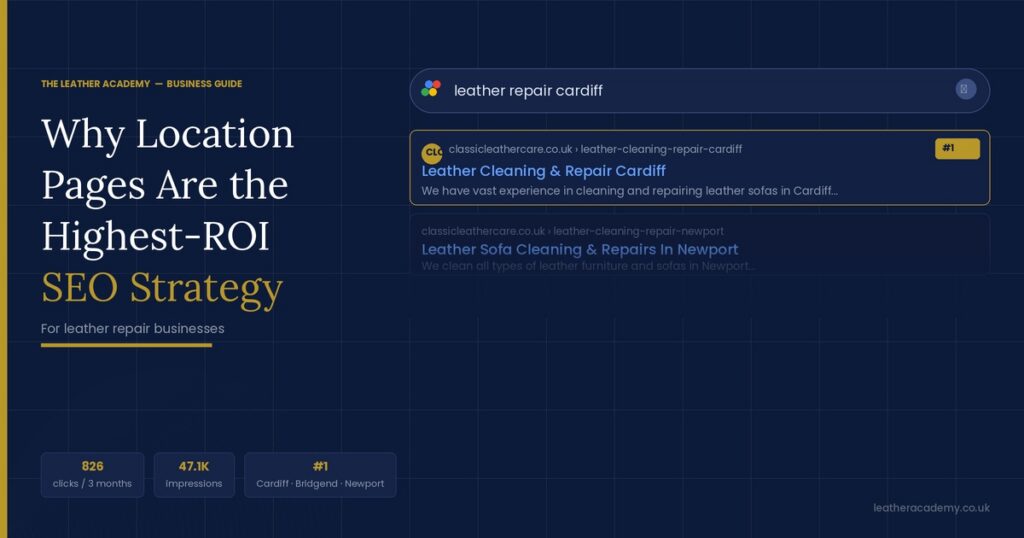
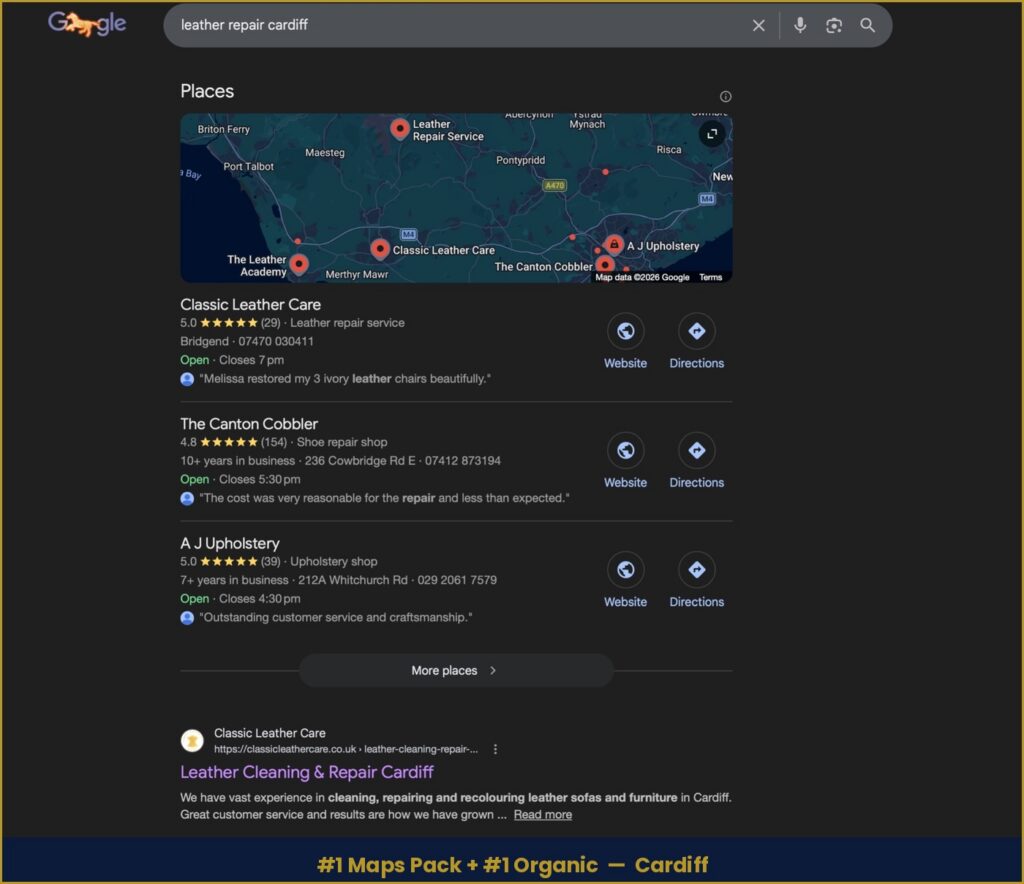
Here’s what that looks like in practice:
Search: ‘leather repair cardiff’ — Classic Leather Care ranks #1 in Google Maps Pack and #1 in organic results
Why this matters more than any other marketing channel
Unlike paid advertising, organic search rankings don’t stop working when you stop paying. A well-built location page continues to attract enquiries weeks, months and years after it was first published.
The other channels – social media, leaflets and word of mouth reach people who may or may not need your service right now. Someone searching ‘leather repair Cardiff’ on Google has a specific problem and is actively looking for someone to solve it and location pages put you in front of these customers.
They provide the cheapest, highest-quality lead a service business can get.
Indeed, paid ads for local service keywords can cost £3–£8 per click or more. A location page that ranks organically delivers the same traffic indefinitely, for free.
What makes a location page actually work
Not all location pages are equal. A thin page with one paragraph of text and the town name mentioned once will struggle to rank. Here’s what separates pages that rank from pages that don’t:
- A unique, descriptive title tag that and meta description includes the service and location (e.g. ‘Leather Repairs in Cardiff’)
- Substantive content – at least 350 words written specifically for that location
- Natural use of location throughout – not keyword-stuffed, but genuinely woven into the copy
- A clear call to action and contact mechanism on the page
- Internal links from the rest of your site to the location page
How many location pages do you need?
Start with your most important locations – the areas you work in most often or where demand is highest. For most leather repair businesses, that means your home town, the nearest large city, and the surrounding areas you’re willing to travel to.
Multiple well-written location pages can build a significant search presence within three to twelve months – and each new page compounds the authority of the ones already published.
One location page, done properly, can generate multiple bookings per month from people who found you through that specific search. At £150–£500 per job, you’d be hard-pressed to find a better return in marketing for a small service business.
Understanding how to find customers, and specifically how to make sure the right customers can find you, is part of running a sustainable business. The approach that built Classic Leather Care’s organic search presence is the same approach we can use to help you grow your business.
your business on Google?
We built Classic Leather Care to rank #1 across South Wales using the same strategies we teach. Now we help other leather repair businesses do the same.